This is a SEO version of BeaufortMemorial. Click here to view full version
« Previous Page Table of Contents Next Page »balloon is removed. A small, wire mesh tube called a stent may be placed in the artery to help hold it open and to reduce the chance that the artery will become blocked again.
Angioplasty reduces angina (chest pain) and shortness of breath associated with CAD. It can also minimize damage to the heart muscle from a heart attack and reduce the risk of death from heart disease in some people.
A hospital stay of a day or two is typical, and recovery can take less than a week.
Tough angioplasty is generally considered safe, side efects can include blood vessel bleeding, an irregular heartbeat, heart attack or kidney damage.
About bypass surgery
Traditional bypass surgery requires cutting the breastbone open and stopping the heart while a heart-lung machine circulates blood. After surgery is complet-ed, the heart usually starts beating again on its own or mild electrical shocks may be used to restart it.
Bypass surgery
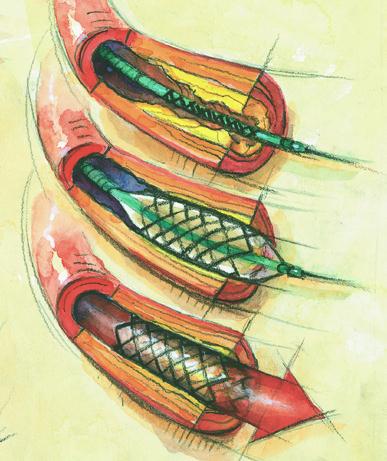
Angioplasty WITH STENT PLACEMENT
Vessel grafts allow blood to bypass blockages.
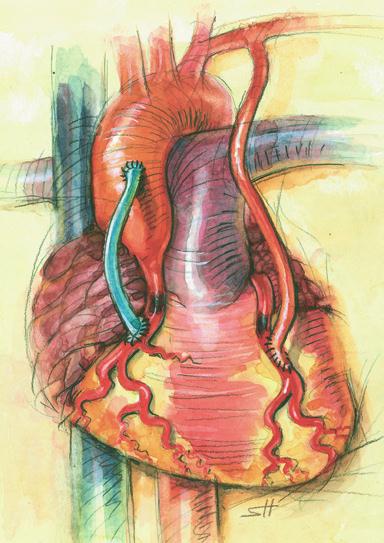
Blockages in coronary arteries
Duke partnership
expands heart program
Beaufort Memorial is afliated with Duke Medicine in cardiovascular care. With the arrival of four new cardiologists to the area last year, the hospital’s Cochrane Heart Center has been very busy providing a broad range of diagnostic services.
In addition to diagnostic cardiac catheterizations, the Cochrane Heart Center ofers nuclear/thallium imaging, pacemakers, internal defbrillators, echocardiography and electrocardiograms.
“Our goal is to provide the highest level of cardiac care we can to our patients,” says Cardiovascular Program Director Daniel Mock. “We are fortunate to have such a strong partner as Duke, because they can guide us in the right direction as we move forward and grow.”
To be able to provide emergency cardiac interventions locally, Beaufort Memorial must attain a Certifcate of Need from the South Carolina Department of Health and Environmental Control. Te State Health Plan requires that a hospital perform a minimum of 600 noninterventional cardiac procedures over a 12-month period. For more information about Beaufort Memorial’s cardiac pro-gram, visit www.bmhsc.org or call 843-522-7700 .
Sometimes a surgeon operates while the heart is still beating. Tis of-pump technique—so named because the technique doesn’t require the use of the heart-lung machine—may reduce the risk for blood transfusions and kidney complications.
During either type of bypass surgery, a healthy artery or vein is removed from another part of the body and then con-nected—or grafted—to the blocked artery. Tis allows blood to fow through the bypass to the heart.
As many as fve blocked major heart arteries can be bypassed during one surgery, according to the American Heart Association.
Traditional bypass surgery generally takes three to fve hours to perform. You may need to recover in the hospital for up to a week and at home for up to 12 weeks or more. Risks include bleeding, reactions to anesthesia, fever, pain, stroke or a heart attack.
BMH
cardiologists:
✓✓ Erasme Coly, MD ✓✓ David Harshman, MD ✓✓ Tomas Schultz, DO ✓✓ M. Shannon Shook, MD ✓✓ Stuart Smalheiser, MD To fnd out more, check out their profles on our website at
www.bmhsc.org . For a FREE refer-ral, call our doctor referral service at
888-522-5585 .
Cofey infographic with information from the National Institutes of Health
1. Closed balloon catheter with compressed stent is inserted.
2. Balloon expands stent.
3. Stent compresses plaque, increasing blood fow.
Tis illustration shows a stent being placed in a coronary artery that has plaque buildup.
1
Watch videos featuring our cardiologists .

www.YouTube.com/Beaufor tMemorial
Doctor Referral Service: 888-522-5585 • Health Scene 31
This is a SEO version of BeaufortMemorial. Click here to view full version
« Previous Page Table of Contents Next Page »